UPSC Prelims 2022
General Studies Paper II (CSAT)
80 questions, 2 hours. Open a question for its answer and why.
- Question 1 · Reading Comprehension
Passage—1 · as printed by UPSC 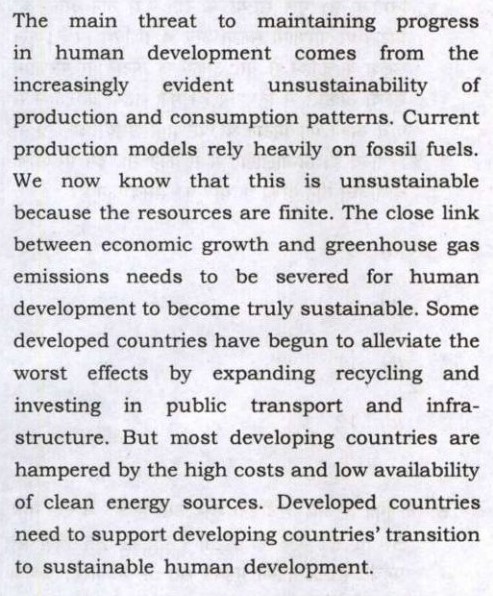
Unsustainability in production pattern is due to which of the following?
- 1.Heavy dependence on fossil fuels
- 2.Limited availability of resources
- 3.Expansion of recycling
Select the correct answer using the code given below.
a1 and 2 onlyb2 onlyc1 and 3 onlyd1, 2 and 3 - Question 2 · Reading Comprehension
Passage—1 · as printed by UPSC Consider the following statements : Developed countries can support developing countries’ transition to sustainable human development by
- 1.making clean energy sources available at low cost
- 2.providing loans for improving their public transport at nominal interest rates
- 3.encouraging them to change their production and consumption patterns
Which of the statements given above is/are correct?
a1 onlyb1 and 2 onlyc2 and 3 onlyd1, 2 and 3 - Question 3 · Reading Comprehension
Passage—2 · as printed by UPSC 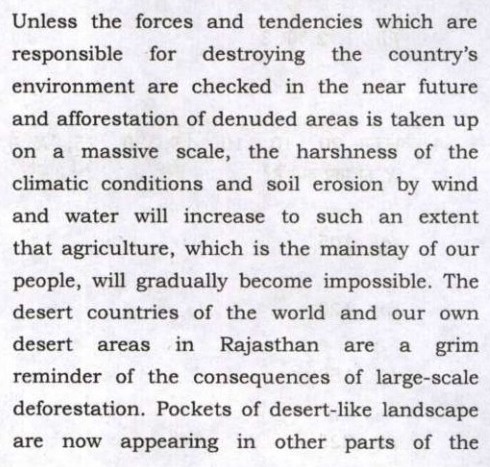
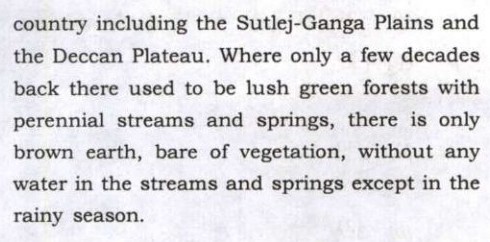
According to the passage given above, deforestation and denudation will ultimately lead to which of the following?
- 1.Depletion of soil resource
- 2.Shortage of land for the common man
- 3.Lack of water for cultivation
Select the correct answer using the code given below.
a1 and 2 onlyb2 and 3 onlyc1 and 3 onlyd1, 2 and 3 - Question 4 · Logical Reasoning and Mental Ability
What is the value of X in the sequence 20, 10, 10, 15, 30, 75, X?
a105b120c150d225 - Question 5 · Basic Numeracy
An Identity Card has the number ABCDEFG, not necessarily in that order, where each letter represents a distinct digit (1, 2, 4, 5, 7, 8, 9 only). The number is divisible by 9. After deleting the first digit from the right, the resulting number is divisible by 6. After deleting two digits from the right of original number, the resulting number is divisible by 5. After deleting three digits from the right of original number, the resulting number is divisible by 4. After deleting four digits from the right of original number, the resulting number is divisible by 3. After deleting five digits from the right of original number, the resulting number is divisible by 2. Which of the following is a possible value for the sum of the middle three digits of the number?
a8b9c11d12 - Question 6 · Logical Reasoning and Mental Ability
Two friends X and Y start running and they run together for 50 m in the same direction and reach a point. X turns right and runs 60 m, while Y turns left and runs 40 m. Then X turns left and runs 50 m and stops, while Y turns right and runs 50 m and then stops. How far are the two friends from each other now?
a100 mb90 mc60 md50 m - Question 7 · Logical Reasoning and Mental Ability
Which date of June 2099 among the following is Sunday?
a4b5c6d7 - Question 8 · Basic Numeracy
A bill for ₹1,840 is paid in the denominations of ₹50, ₹20 and ₹10 notes. 50 notes in all are used. Consider the following statements :
- 1.25 notes of ₹50 are used and the remaining are in the denominations of ₹20 and ₹10.
- 2.35 notes of ₹20 are used and the remaining are in the denominations of ₹50 and ₹10.
- 3.20 notes of ₹10 are used and the remaining are in the denominations of ₹50 and ₹20.
Which of the above statements are not correct?
a1 and 2 onlyb2 and 3 onlyc1 and 3 onlyd1, 2 and 3 - Question 9 · Basic Numeracy
Which number amongst 2^40, 3^21, 4^18 and 8^12 is the smallest?
a2^40b3^21c4^18d8^12 - Question 10 · Basic Numeracy
The digits 1 to 9 are arranged in three rows in such a way that each row contains three digits, and the number formed in the second row is twice the number formed in the first row; and the number formed in the third row is thrice the number formed in the first row. Repetition of digits is not allowed. If only three of the four digits 2, 3, 7 and 9 are allowed to use in the first row, how many such combinations are possible to be arranged in the three rows?
a4b3c2d1 - Question 11 · Reading Comprehension
Passage—1 · as printed by UPSC 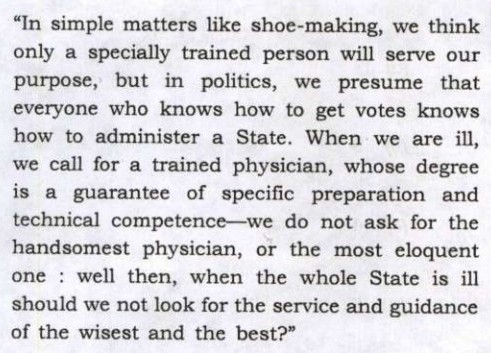
Which one of the following statements best reflects the message of the author of the passage?
aWe assume that in a democracy, any politician is qualified to administer a State.bPoliticians should be selected from those trained in administration.cWe need to devise a method of barring incompetence from public office.dAs voters select their administrators, the eligibility of politicians to administer a State cannot be questioned. - Question 12 · Reading Comprehension
Passage—2 · as printed by UPSC 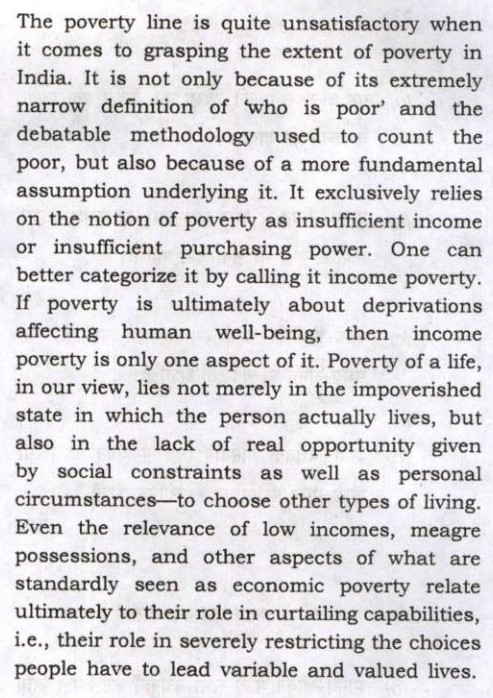
Why is the methodology adopted in India to count the ‘poor’ debatable?
aThere is some confusion regarding what should constitute the ‘poverty line’.bThere are wide diversities in the condition of the rural and urban poor.cThere is no uniform global standard for measuring income poverty.dIt is based on the proposition of poverty as meagre income or buying capacity. - Question 13 · Reading Comprehension
Passage—2 · as printed by UPSC Why is income poverty only one measure of counting the ‘poor’ ?
aIt talks of only one kind of deprivation ignoring all others.bOther deprivations in a human life have nothing to do with lack of purchasing power.cIncome poverty is not a permanent condition, it changes from time to time.dIncome poverty restricts human choices only at a point of time. - Question 14 · Reading Comprehension
Passage—2 · as printed by UPSC What does the author mean by ‘poverty of a life’?
aAll deprivations in a human life which stem not only from lack of income but lack of real opportunitiesbImpoverished state of poor people in rural and urban areascMissed opportunities in diverse personal circumstancesdMaterial as well as non-material deprivations in a human life which restrict human choices permanently - Question 15 · Basic Numeracy
X and Y run a 3 km race along a circular course of length 300 m. Their speeds are in the ratio 3 : 2. If they start together in the same direction, how many times would the first one pass the other (the start-off is not counted as passing)?
a2b3c4d5 - Question 16 · Logical Reasoning and Mental Ability
If the order of the letters in the English alphabet is reversed and each letter represents the letter whose position it occupies, then which one of the following represents ‘LUCKNOW’?
aOGXPMLDbOGXQMLEcOFXPMLEdOFXPMLD - Question 17 · Basic Numeracy
In a tournament of Chess having 150 entrants, a player is eliminated whenever he loses a match. It is given that no match results in a tie/draw. How many matches are played in the entire tournament?
a151b150c149d148 - Question 18 · Basic Numeracy
How many 3-digit natural numbers (without repetition of digits) are there such that each digit is odd and the number is divisible by 5 ?
a8b12c16d24 - Question 19 · Data Interpretation
Consider the Question and two Statements given below :
- QuestionIs x an integer?
- Statement–1x / 3 is not an integer.
- Statement–23x is an integer.
Which one of the following is correct in respect of the Question and the Statements?
aStatement–1 alone is sufficient to answer the QuestionbStatement–2 alone is sufficient to answer the QuestioncBoth Statement–1 and Statement–2 are sufficient to answer the QuestiondBoth Statement–1 and Statement–2 are not sufficient to answer the Question - Question 20 · Basic Numeracy
The increase in the price of a certain item was 25%. Then the price was decreased by 20% and then again increased by 10%. What is the resultant increase in the price?
a5%b10%c12·5%d15% - Question 21 · Reading Comprehension
Passage · as printed by UPSC 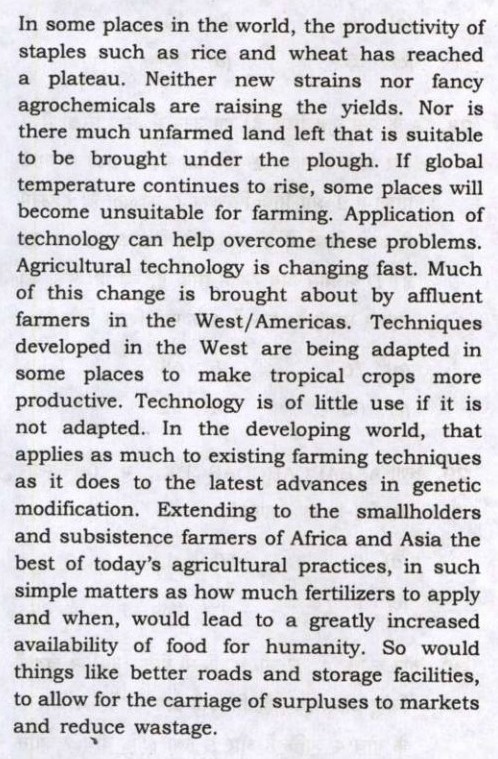
Based on the above passage, the following assumptions have been made :
- 1.Development of agricultural technology is confined to developed countries.
- 2.Agricultural technology is not adapted in developing countries.
Which of the above assumptions is/are valid?
a1 onlyb2 onlycBoth 1 and 2dNeither 1 nor 2 - Question 22 · Reading Comprehension
Passage · as printed by UPSC Based on the above passage, the following assumptions have been made :
- 1.Poor countries need to bring about change in their existing farming techniques.
- 2.Developed countries have better infrastructure and they waste less food.
Which of the above assumptions is/are valid?
a1 onlyb2 onlycBoth 1 and 2dNeither 1 nor 2 - Question 23 · Reading Comprehension
Passage · as printed by UPSC Based on the above passage, the following assumptions have been made :
- 1.Growing enough food for future generations will be a challenge.
- 2.Corporate farming is a viable option for food security in poor countries.
Which of the above assumptions is/are valid?
a1 onlyb2 onlycBoth 1 and 2dNeither 1 nor 2 - Question 24 · Basic Numeracy
The letters A, B, C, D and E are arranged in such a way that there are exactly two letters between A and E. How many such arrangements are possible?
a12b18c24d36 - Question 25 · Data Interpretation
Consider the Question and two Statements given below :
- QuestionIs Z brother of X?
- Statement–1X is a brother of Y and Y is a brother of Z.
- Statement–2X, Y and Z are siblings.
Which one of the following is correct in respect of the Question and the Statements?
aStatement–1 alone is sufficient to answer the QuestionbStatement–2 alone is sufficient to answer the QuestioncBoth Statement–1 and Statement–2 are sufficient to answer the QuestiondBoth Statement–1 and Statement–2 are not sufficient to answer the Question - Question 26 · Basic Numeracy
On one side of a 1·01 km long road, 101 plants are planted at equal distance from each other. What is the total distance between 5 consecutive plants?
a40 mb40·4 mc50 md50·5 m - Question 27 · Basic Numeracy
A, B and C are three places such that there are three different roads from A to B, four different roads from B to C and three different roads from A to C. In how many different ways can one travel from A to C using these roads?
a10b13c15d36 - Question 28 · Basic Numeracy
A has some coins. He gives half of the coins and 2 more to B. B gives half of the coins and 2 more to C. C gives half of the coins and 2 more to D. The number of coins D has now, is the smallest two-digit number. How many coins does A have in the beginning?
a76b68c60d52 - Question 29 · Logical Reasoning and Mental Ability
In the series AABABCABCDABCDE.., which letter appears at the 100th place?
aGbHcIdJ - Question 30 · Logical Reasoning and Mental Ability
Three persons A, B and C are standing in a queue not necessarily in the same order. There are 4 persons between A and B, and 7 persons between B and C. If there are 11 persons ahead of C and 13 behind A, what could be the minimum number of persons in the queue?
a22b28c32d38 - Question 31 · Reading Comprehension
Passage—1 · as printed by UPSC 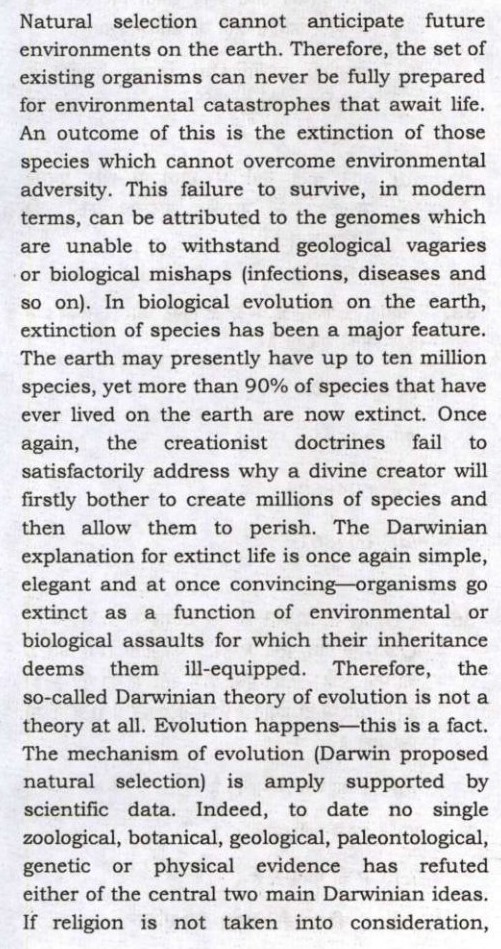
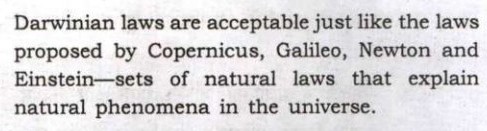
According to the passage, natural selection cannot anticipate future environments on the earth as
- 1.species not fully prepared to face the environmental changes that await them will face extinction
- 2.all the existing species would get extinct as their genomes will not withstand biological mishaps
- 3.inability of the genome to withstand environmental changes would result in extinction
- 4.extinction of species is a common feature
Select the correct answer using the code given below.
a1, 2 and 3b2, 3 and 4c1, 3 and 4d1, 2 and 4 - Question 32 · Reading Comprehension
Passage—1 · as printed by UPSC The passage suggests that Darwinian theory of evolution is not a theory at all because
ait does not satisfy the creationist doctrinebextinction is a function of environment and biological assaultscthere are no evidences to refute itdexistence of organisms is attributed to a creator - Question 33 · Reading Comprehension
Passage—1 · as printed by UPSC With reference to the passage, the following assumptions have been made :
- 1.Only species that have the ability to overcome environmental catastrophes will survive and perpetuate.
- 2.More than 90% of the species on the earth are in the danger of getting extinct due to drastic changes in the environment.
- 3.Darwin’s theory explains all the natural phenomena.
Which of the above assumptions is/are valid?
a1 onlyb1 and 2 onlyc3 onlyd1, 2 and 3 - Question 34 · Reading Comprehension
Passage—2 · as printed by UPSC 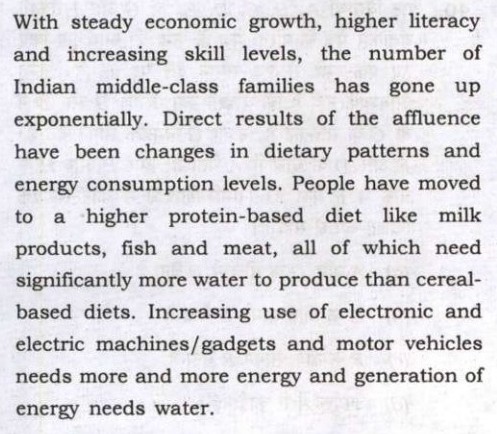
Which one of the following statements best reflects the crux of the passage?
aPeople should be persuaded to continue with the mainly Indian traditional cereal-based diets.bIndia needs to focus on developing agricultural productivity and capacity for more energy generation in the coming years.cModern technological developments result in the change of cultural and social behaviour of the people.dWater management practices in India need to change dramatically in the coming years. - Question 35 · Basic Numeracy
How many seconds in total are there in x weeks, x days, x hours, x minutes and x seconds?
a11580xb11581xc694860xd694861x - Question 36 · Logical Reasoning and Mental Ability
P, Q, R, S, T and U are six members of a family. R is the spouse of Q. U is the mother of T and S is the daughter of U. P’s daughter is T and R’s son is P. There are two couples in the family. Which one of the following is correct?
aQ is the grandfather of TbQ is the grandmother of TcR is the mother of PdT is the granddaughter of Q - Question 37 · Data Interpretation
Consider the Question and two Statements given below in respect of three cities P, Q and R in a State :
- QuestionHow far is city P from city Q?
- Statement–1City Q is 18 km from city R.
- Statement–2City P is 43 km from city R.
Which one of the following is correct in respect of the Question and the Statements?
aStatement–1 alone is sufficient to answer the QuestionbStatement–2 alone is sufficient to answer the QuestioncBoth Statement–1 and Statement–2 are sufficient to answer the QuestiondBoth Statement–1 and Statement–2 are not sufficient to answer the Question - Question 38 · Logical Reasoning and Mental Ability
Two Statements followed by four Conclusions are given below. You have to take the Statements to be true even if they seem to be at variance from the commonly known facts. Read all the Conclusions and then decide which of the given Conclusions logically follows/follow from the Statements, disregarding the commonly known facts :
- Statement–1All pens are books.
- Statement–2No chair is a pen.
- Conclusion–IAll chairs are books.
- Conclusion–IISome chairs are pens.
- Conclusion–IIIAll books are chairs.
- Conclusion–IVNo chair is a book.
Which one of the following is correct?
aOnly Conclusion–IbOnly Conclusion–IIcBoth Conclusion–III and Conclusion–IVdNone of the Conclusions follows - Question 39 · Logical Reasoning and Mental Ability
Three Statements followed by three Conclusions are given below. You have to take the Statements to be true even if they seem to be at variance from the commonly known facts. Read all the Conclusions and then decide which of the given Conclusions logically follows/follow from the Statements, disregarding the commonly known facts :
- Statement–1Some doctors are teachers.
- Statement–2All teachers are engineers.
- Statement–3All engineers are scientists.
- Conclusion–ISome scientists are doctors.
- Conclusion–IIAll engineers are doctors.
- Conclusion–IIISome engineers are doctors.
Which one of the following is correct?
aOnly Conclusion–IbOnly Conclusion–IIcBoth Conclusion–I and Conclusion–IIIdBoth Conclusion–I and Conclusion–II - Question 40 · Logical Reasoning and Mental Ability
Eight students A, B, C, D, E, F, G and H sit around a circular table, equidistant from each other, facing the centre of the table, not necessarily in the same order. B and D sit neither adjacent to C nor opposite to C. A sits in between E and D, and F sits in between B and H. Which one of the following is definitely correct?
aB sits in between A and GbC sits opposite to GcE sits opposite to FdNone of the above - Question 41 · Reading Comprehension
Passage—1 · as printed by UPSC 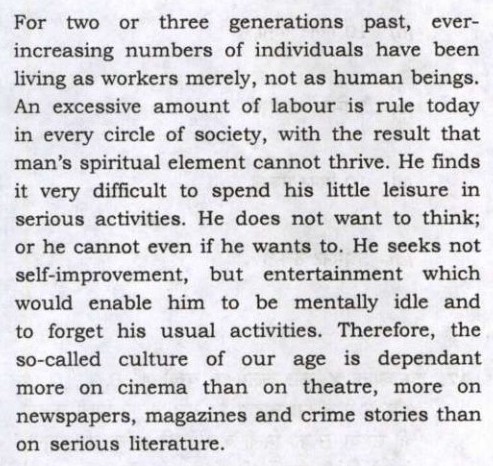
The passage is based on the idea that
aman should not work hardbthe great evil of our age is overstraincman cannot think welldman cannot care for his spiritual welfare - Question 42 · Reading Comprehension
Passage—1 · as printed by UPSC Man does not seek self-improvement because he
ais not intellectually capablebhas no time to do socis distracted by materialismdloves amusement and is mentally idle - Question 43 · Reading Comprehension
Passage—2 · as printed by UPSC 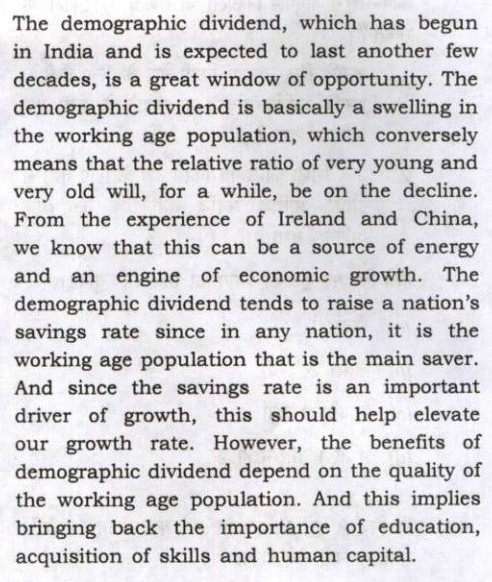
Which of the following would invariably happen in a country, when the demographic dividend has begun to operate?
- 1.The number of illiterate people will decrease.
- 2.The ratio of very old and very young will decrease for a while.
- 3.Population growth rate will quickly stabilize.
Select the correct answer using the code given below.
a1 and 2 onlyb2 onlyc1 and 3 onlyd1, 2 and 3 - Question 44 · Reading Comprehension
Passage—2 · as printed by UPSC With reference to the passage, which of the following inferences can be drawn?
- 1.Demographic dividend is an essential condition for a country to rapidly increase its economic growth rate.
- 2.Promotion of higher education is an essential condition for a country for its rapid economic growth.
Select the correct answer using the code given below.
a1 onlyb2 onlycBoth 1 and 2dNeither 1 nor 2 - Question 45 · Basic Numeracy
Five friends P, Q, X, Y and Z purchased some notebooks. The relevant information is given below :
- 1.Z purchased 8 notebooks more than X did.
- 2.P and Q together purchased 21 notebooks.
- 3.Q purchased 5 notebooks less than P did.
- 4.X and Y together purchased 28 notebooks.
- 5.P purchased 5 notebooks more than X did.
If each notebook is priced ₹40, then what is the total cost of all the notebooks?
a₹2,600b₹2,400c₹2,360d₹2,320 - Question 46 · Basic Numeracy
A man started from home at 14:30 hours and drove to village, arriving there when the village clock indicated 15:15 hours. After staying for 25 minutes, he drove back by a different route of length 1·25 times the first route at a rate twice as fast reaching home at 16:00 hours. As compared to the clock at home, the village clock is
a10 minutes slowb5 minutes slowc10 minutes fastd5 minutes fast - Question 47 · Basic Numeracy
A person X wants to distribute some pens among six children A, B, C, D, E and F. Suppose A gets twice the number of pens received by B, three times that of C, four times that of D, five times that of E and six times that of F. What is the minimum number of pens X should buy so that the number of pens each one gets is an even number?
a147b150c294d300 - Question 48 · Data Interpretation
Six persons A, B, C, D, E and F are sitting equidistant from each other around a circular table (facing the centre of the table). Consider the Question and two Statements given below :
- QuestionWho is sitting on the immediate left of A?
- Statement–1B is sitting opposite to C and D is sitting opposite to E.
- Statement–2F is sitting on the immediate left of B.
Which one of the following is correct in respect of the Question and the Statements?
aStatement–1 alone is sufficient to answer the QuestionbStatement–2 alone is sufficient to answer the QuestioncBoth Statement–1 and Statement–2 are sufficient to answer the QuestiondBoth Statement–1 and Statement–2 are not sufficient to answer the Question - Question 49 · Data Interpretation
Consider the Question and two Statements given below :
- QuestionWhat is the age of Manisha?
- Statement–1Manisha is 24 years younger than her mother.
- Statement–25 years later, the ages of Manisha and her mother will be in the ratio 3: 5.
Which one of the following is correct in respect of the Question and the Statements?
aStatement–1 alone is sufficient to answer the QuestionbStatement–2 alone is sufficient to answer the QuestioncBoth Statement–1 and Statement–2 are sufficient to answer the QuestiondBoth Statement–1 and Statement–2 are not sufficient to answer the Question - Question 50 · Data Interpretation
Six lectures A, B, C, D, E and F, each of one hour duration, are scheduled between 8:00 a.m. and 2:00 p.m. Consider the Question and two Statements given below :
- QuestionWhich lecture is in the third period?
- Statement–1Lecture F is preceded by A and followed by C.
- Statement–2There is no lecture after lecture B.
Which one of the following is correct in respect of the Question and the Statements?
aStatement–1 alone is sufficient to answer the QuestionbStatement–2 alone is sufficient to answer the QuestioncBoth Statement–1 and Statement–2 are sufficient to answer the QuestiondBoth Statement–1 and Statement–2 are not sufficient to answer the Question - Question 51 · Reading Comprehension
Passage—1 · as printed by UPSC 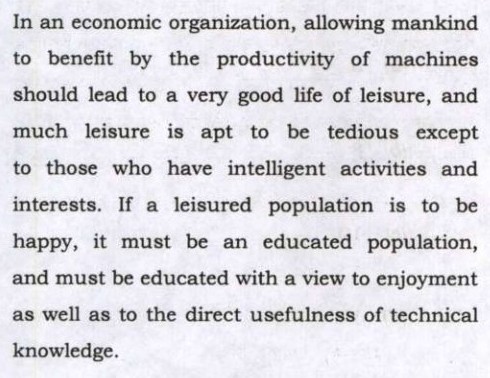
Which of the following statements best reflects the underlying tone of the passage?
aOnly an educated population can best make use of the benefits of economic progress.bAll economic development should be aimed at the creation of leisure.cAn increase in the educated population of a country leads to an increase in the happiness of its people.dUse of machines should be encouraged in order to create a large leisured population. - Question 52 · Reading Comprehension
Passage—2 · as printed by UPSC 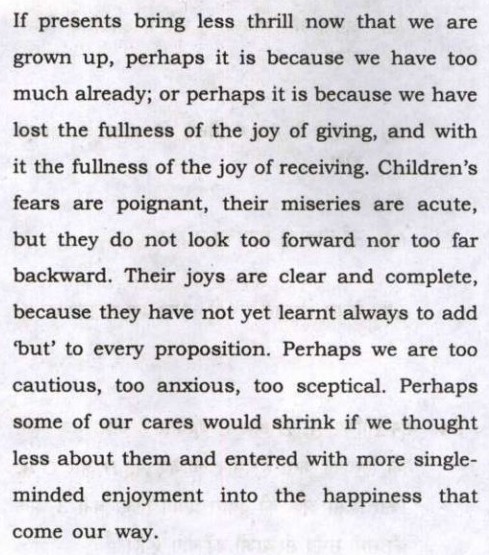
With reference to the passage, which one of the following statements is correct?
aIt is not possible for adults to feel thrilled by presents.bThere can be more than one reason why adults feel less thrilled by presents.cThe author does not know why adults feel less thrilled by presents.dAdults have less capacity to feel the joy of loving or being loved. - Question 53 · Reading Comprehension
Passage—2 · as printed by UPSC The author of the passage is against
aworrying too much about the past and futurebbeing in the habit of thinking about presentscnot being thrilled by new thingsdgiving and receiving joy only partially - Question 54 · Basic Numeracy
Let A, B and C represent distinct non-zero digits. Suppose x is the sum of all possible 3-digit numbers formed by A, B and C without repetition. Consider the following statements :
- 1.The 4-digit least value of x is 1332.
- 2.The 3-digit greatest value of x is 888.
Which of the above statements is/are correct?
a1 onlyb2 onlycBoth 1 and 2dNeither 1 nor 2 - Question 55 · Basic Numeracy
There is a numeric lock which has a 3-digit PIN. The PIN contains digits 1 to 7. There is no repetition of digits. The digits in the PIN from left to right are in decreasing order. Any two digits in the PIN differ by at least 2. How many maximum attempts does one need to find out the PIN with certainty?
a6b8c10d12 - Question 56 · Basic Numeracy
There are eight equidistant points on a circle. How many right-angled triangles can be drawn using these points as vertices and taking the diameter as one side of the triangle?
a24b16c12d8 - Question 57 · Basic Numeracy
24 men and 12 women can do a piece of work in 30 days. In how many days can 12 men and 24 women do the same piece of work?
a30 daysbMore than 30 dayscLess than 30 days or more than 30 daysdData is inadequate to draw any conclusion - Question 58 · Basic Numeracy
What is the remainder when 91×92×93×94×95×96×97×98×99 is divided by 1261?
a3b2c1d0 - Question 59 · Basic Numeracy
Consider the following statements in respect of a rectangular sheet of length 20 cm and breadth 8 cm :
- 1.It is possible to cut the sheet exactly into 4 square sheets.
- 2.It is possible to cut the sheet into 10 triangular sheets of equal area.
Which of the above statements is/are correct?
a1 onlyb2 onlycBoth 1 and 2dNeither 1 nor 2 - Question 60 · Basic Numeracy
When 70% of a number x is added to another number y, the sum becomes 165% of the value of y. When 60% of the number x is added to another number z, then the sum becomes 165% of the value of z. Which one of the following is correct?
az < x < ybx < y < zcy < x < zdz < y < x - Question 61 · Reading Comprehension
Passage—1 · as printed by UPSC 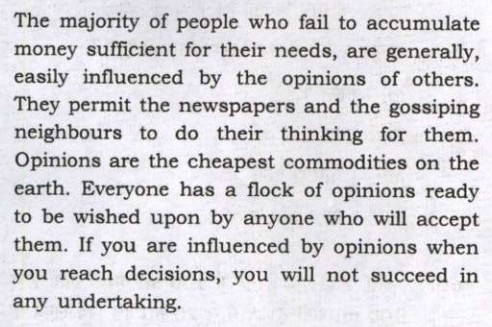
Which one of the following is implied by the passage?
aMost of the people do not accumulate money for their needs.bMost of the people never fail to accumulate money for their needs.cThere are people who fail to accumulate money for their needs.dThere is no need to accumulate money. - Question 62 · Reading Comprehension
Passage—1 · as printed by UPSC What is the main idea of the passage?
aPeople should not be influenced by the opinions of others.bPeople should accumulate as much money as they can.cPeople should neither give nor accept the opinions.dPeople will succeed in any undertaking if they do not accept any opinion at all. - Question 63 · Reading Comprehension
Passage—2 · as printed by UPSC 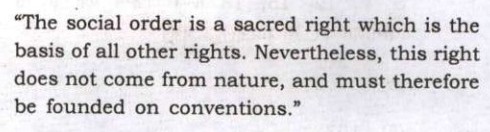
With reference to the above passage, which of the following statements is/are correct?
- 1.Conventions are the sources of rights of man.
- 2.Rights of man can be exercised only when there is a social order.
Select the correct answer using the code given below.
a1 onlyb2 onlycBoth 1 and 2dNeither 1 nor 2 - Question 64 · Basic Numeracy
Two candidates X and Y contested an election. 80% of voters cast their vote and there were no invalid votes. There was no NOTA (None of the above) option. X got 56% of the votes cast and won by 1440 votes. What is the total number of voters in the voters list?
a15000b12000c9600d5000 - Question 65 · Basic Numeracy
What is the smallest number greater than 1000 that when divided by any one of the numbers 6, 9, 12, 15, 18 leaves a remainder of 3?
a1063b1073c1083d1183 - Question 66 · Basic Numeracy
Let p be a two-digit number and q be the number consisting of same digits written in reverse order. If p×q = 2430, then what is the difference between p and q?
a45b27c18d9 - Question 67 · Basic Numeracy
Consider the following statements in respect of two natural numbers p and q such that p is a prime number and q is a composite number :
- 1.p×q can be an odd number.
- 2.q/p can be a prime number.
- 3.p+q can be a prime number.
Which of the above statements are correct?
a1 and 2 onlyb2 and 3 onlyc1 and 3 onlyd1, 2 and 3 - Question 68 · Logical Reasoning and Mental Ability
Consider the following statements :
- 1.Between 3:16 p.m. and 3:17 p.m., both hour hand and minute hand coincide.
- 2.Between 4:58 p.m. and 4:59 p.m., both minute hand and second hand coincide.
Which of the above statements is/are correct?
a1 onlyb2 onlycBoth 1 and 2dNeither 1 nor 2 - Question 69 · Basic Numeracy
There are two containers X and Y. X contains 100 ml of milk and Y contains 100 ml of water. 20 ml of milk from X is transferred to Y. After mixing well, 20 ml of the mixture in Y is transferred back to X. If m denotes the proportion of milk in X and n denotes the proportion of water in Y, then which one of the following is correct?
am = nbm > ncm < ndCannot be determined due to insufficient data - Question 70 · Data Interpretation
A pie chart gives the expenditure on five different items A, B, C, D and E in a household. If B, C, D and E correspond to 90°, 50°, 45° and 75° respectively, then what is the percentage of expenditure on item A?
a112/9b125/6c155/9d250/9 - Question 71 · Reading Comprehension
Passage—1 · as printed by UPSC 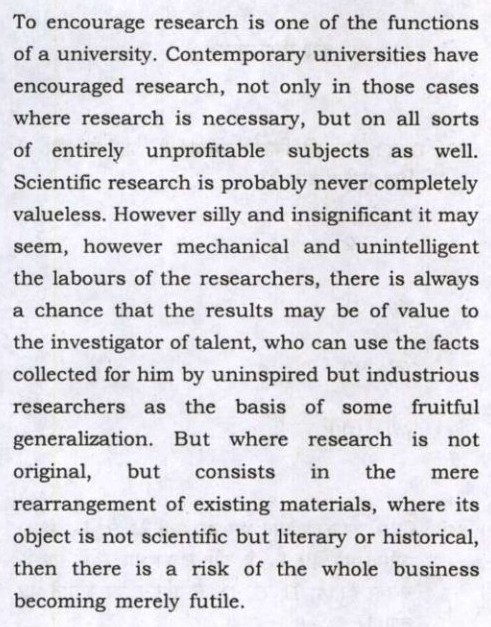
The author’s assumption about scientific research is that
ait is never very valuablebit is sometimes very valuablecit is never without some valuedit is always very valuable - Question 72 · Reading Comprehension
Passage—1 · as printed by UPSC According to the author
anot many research results can be of value to an intelligent investigatorba research result is always valuable to an intelligent investigatorcany research result can be of value to an intelligent investigatorda research result must always be of some value to an intelligent investigator - Question 73 · Reading Comprehension
Passage—2 · as printed by UPSC 
Which one of the following best reflects the practical, rational and lasting solution?
aConstructing huge concrete storage tanks and canals across the countrybChanging the cropping patterns and farming practicescInterlinking of rivers across the countrydBuffer stocking of water through dams and recharging aquifers - Question 74 · Basic Numeracy
If 15×14×13×···×3×2×1 = 3^m × n where m and n are positive integers, then what is the maximum value of m ?
a7b6c5d4 - Question 75 · Logical Reasoning and Mental Ability
What is the value of X in the sequence 2, 12, 36, 80, 150, X?
a248b252c258d262 - Question 76 · Basic Numeracy
One non-zero digit, one vowel and one consonant from English alphabet (in capital) are to be used in forming passwords, such that each password has to start with a vowel and end with a consonant. How many such passwords can be generated?
a105b525c945d1050 - Question 77 · Basic Numeracy
There are 9 cups placed on a table arranged in equal number of rows and columns out of which 6 cups contain coffee and 3 cups contain tea. In how many ways can they be arranged so that each row should contain at least one cup of coffee?
a18b27c54d81 - Question 78 · Basic Numeracy
The sum of three consecutive integers is equal to their product. How many such possibilities are there?
aOnly onebOnly twocOnly threedNo such possibility is there - Question 79 · Basic Numeracy
What is the number of numbers of the form 0·XY, where X and Y are distinct non-zero digits?
a72b81c90d100 - Question 80 · Basic Numeracy
The average weight of A, B, C is 40 kg, the average weight of B, D, E is 42 kg and the weight of F is equal to that of B. What is the average weight of A, B, C, D, E and F ?
a40·5 kgb40·8 kgc41 kgdCannot be determined as data is inadequate
Source: UPSC, Civil Services (Preliminary) Examination 2022, General Studies Paper II (CSAT), Series A. The paper on upsc.gov.in.