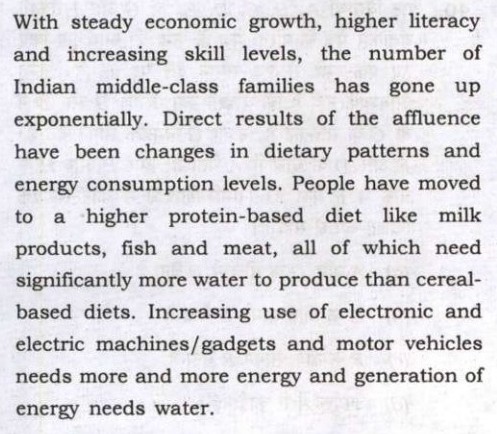
Which one of the following statements best reflects the crux of the passage?
aPeople should be persuaded to continue with the mainly Indian traditional cereal-based diets.
bIndia needs to focus on developing agricultural productivity and capacity for more energy generation in the coming years.
cModern technological developments result in the change of cultural and social behaviour of the people.
dWater management practices in India need to change dramatically in the coming years.
AnswerUPSC’s answer is (d).
The passage traces how a growing middle class has moved to protein-rich foods and to more machines, gadgets and vehicles, each of which needs far more water, directly or through the energy it uses. Its thrust is rising water demand, so the crux is that the way water is managed in India must change sharply. Diet, farm productivity, energy and cultural change appear only as links in that chain, not as the main point.
Why each option is right or wrong
(a) Wrong: the passage notes the diet shift but does not urge people to return to cereals.
(b) Wrong: productivity and energy generation are not the aim; water is the concern.
(c) Wrong: the passage does not discuss technology changing culture.
(d) Correct: higher water demand from diets and energy use calls for changed water management.
Answer: UPSC’s key. Explanation: written by UPSC Grade, not by UPSC.