UPSC Prelims 2026 · CSAT
Question 6: Reading Comprehension
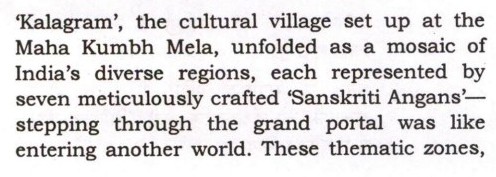
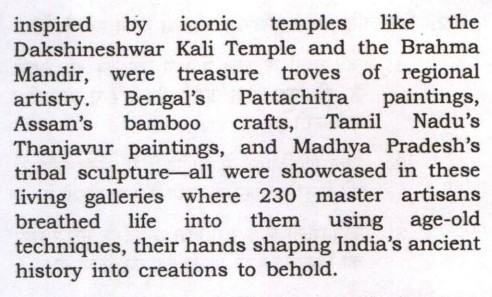
Which of the following conclusions are valid?
- 1.Seven Sanskriti Angans, representing different regions of India, had been showcased in Kalagram.
- 2.Regional artistry was recognised via the inspiration drawn from iconic temples.
- 3.India’s ancient history had been crafted by the contemporary craftsmanship of 230 artisans into creations to behold.
- 4.Art forms from all regions of India had been showcased in these living galleries.
Select the answer using the code given below.
AnswerUPSC’s answer is (a).
Check each conclusion against the passage. It says the village showed India's regions through seven themed zones, and that these zones, inspired by famous temples, were rich in regional artistry, so 1 and 2 hold. Statement 3 contradicts it: the artisans worked with traditional methods, not contemporary craftsmanship. Statement 4 over-reaches: only four regional examples are named, which is not art from all regions.
- 1. The village represented India's regions through seven themed zones.
- 2. The temple-inspired zones are described as rich in regional artistry.
- 3. The artisans used traditional techniques, so 'contemporary' contradicts the passage.
- 4. Only four regional examples are named; 'all regions' goes beyond the text.
How you could have got this
- If you were sure statement 2 is correct, (d) goes: it leaves 2 out.
What you needed to know: The temple-inspired zones are described as rich in regional artistry.
- Then, if you were sure statement 4 is not correct, (b) and (c) go: each of them includes 4.
What you needed to know: Only four regional examples are named; 'all regions' goes beyond the text.
Only (a) is left. You didn’t need statements 1 or 3.
This follows UPSC’s provisional key; the final key could change it.
Which options go is worked out from UPSC’s key and the options, not by a model.
Why each option is right or wrong
- (a) Right: 1 and 2 are supported, while 3 and 4 are not.
- (b) Wrong: 3 misstates the traditional methods and 4 overgeneralises to all regions.
- (c) Wrong: 4 claims all regions, but only four examples are given.
- (d) Wrong: 3 says contemporary craftsmanship, against the passage; 2 is valid and is missing.
Only the provisional key (27 May 2026) was found; the final key replaces it when found.
Answer: UPSC’s key. Explanation: written by UPSC Grade, not by UPSC.
Source: UPSC, Civil Services (Preliminary) Examination 2026, General Studies Paper II (CSAT), Series A. The paper on upsc.gov.in.