UPSC Prelims 2019 · CSAT
Question 65: Reading Comprehension
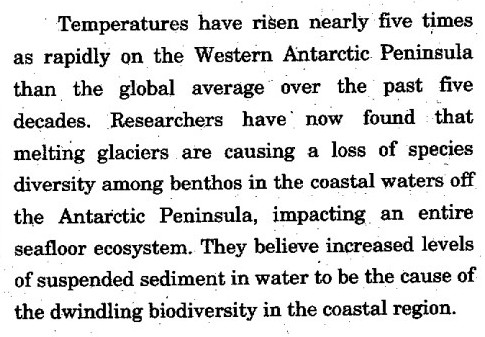
On the basis of the above passage, the following assumptions have been made :
- 1.Regions of glaciers warm faster than other regions due to global warming.
- 2.Global warming can lead to seafloor sedimentation in some areas.
- 3.Melting glaciers can reduce marine biodiversity in some areas.
Which of the above assumptions is/are valid?
AnswerUPSC’s answer is (c).
The passage says melting glaciers cause loss of seafloor species diversity near the Antarctic Peninsula, probably through more suspended sediment in the water. So global warming can bring seafloor sedimentation (2) and melting glaciers can lower marine biodiversity in some areas (3). Assumption 1 over-generalises: the passage reports fast warming on one peninsula, not that glacier regions in general warm faster than others.
- 1. Only one peninsula's warming is reported; no rule for glacier regions is stated.
- 2. Melting glaciers add sediment to coastal water, which affects the seafloor.
- 3. Melting glaciers are said to cut the species diversity of seafloor animals.
How you could have got this
- If you were sure statement 1 is not correct, (a) and (d) go: each of them includes 1.
What you needed to know: Only one peninsula's warming is reported; no rule for glacier regions is stated.
- Then, if you were sure statement 2 is correct, (b) goes: it leaves 2 out.
What you needed to know: Melting glaciers add sediment to coastal water, which affects the seafloor.
Only (c) is left. You didn’t need statement 3.
Which options go is worked out from UPSC’s key and the options, not by a model.
Why each option is right or wrong
- (a) Wrong: 1 generalises from one region.
- (b) Wrong: 2 also follows.
- (c) Right: 2 and 3 follow from sediment released by melting glaciers.
- (d) Wrong: 1 is unsupported.
Answer: UPSC’s key. Explanation: written by UPSC Grade, not by UPSC.
Source: UPSC, Civil Services (Preliminary) Examination 2019, General Studies Paper II (CSAT), Series A. The paper on upsc.gov.in.