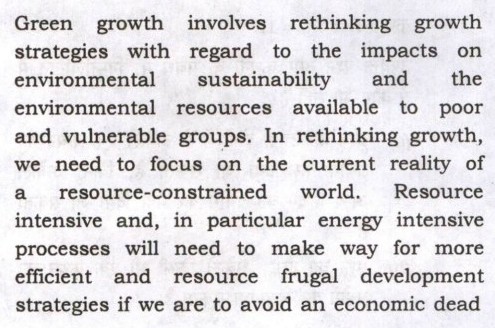
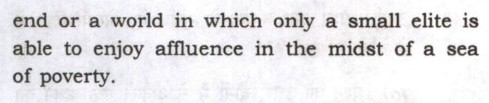
Which one of the following statements best reflects the crux of the above passage?
aEnvironmental sustainability is inimical to our objective of achieving a high rate of GDP growth.
bPoverty eradication is not possible without a rapid economic growth and the consequent environmental degradation.
cMaintaining high environmental standards is now a prerequisite for achieving a steady, sufficient and inclusive growth.
dWith large populations, rampant poverty and limited resources of today's world, environmental degradation cannot be prevented and inequalities are inevitable.
AnswerUPSC’s answer is (c).
The passage says growth must be rethought for a world limited in resources: energy-hungry and resource-heavy methods must give way to efficient, frugal ones, otherwise we face a dead end or a world where a few are rich amid widespread poverty. The crux is that environmental sustainability is a condition for steady and inclusive growth: option (c). It does not oppose growth, nor accept degradation as inevitable.
Why each option is right or wrong
(a) Wrong. The passage does not oppose growth; it asks for a different kind of growth.
(b) Wrong. It does not say poverty removal needs environmental damage.
(c) Right. Environmental limits are a condition for steady and inclusive growth.
(d) Wrong. It does not say degradation and inequality are unavoidable.
Answer: UPSC’s key. Explanation: written by UPSC Grade, not by UPSC.