UPSC Prelims 2021 · CSAT
Question 33: Reading Comprehension
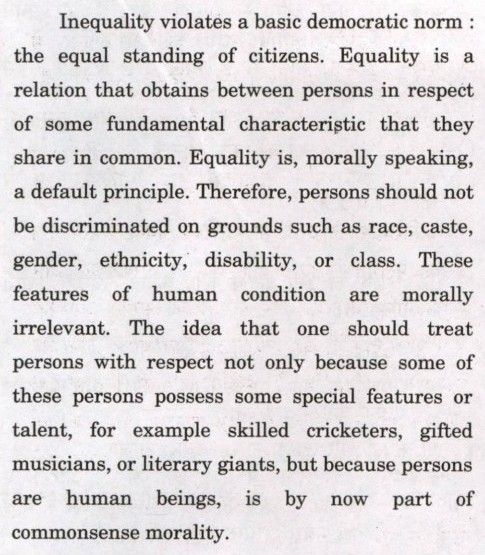
With reference to the above passage, the following assumptions have been made :
- 1.Equality is a prerequisite for people to participate in the multiple transactions of society from a position of confidence.
- 2.Occurrence of inequality is detrimental to the survival of democracy.
- 3.Equal standing of all citizens is an idea that cannot actually be realised even in a democracy.
- 4.Right to equality should be incorporated into our values and day-to-day political vocabulary.
Which of the above assumptions are valid ?
AnswerUPSC’s answer is (c).
Match each assumption with the passage. It treats equal standing of citizens as a basic democratic norm and says people deserve respect simply because they are human, making equality the default. Assumption 1 follows: equal standing is what lets people take part in society's dealings with confidence. Assumption 4 follows: respect for persons as equals is already part of everyday morality, so the right belongs in our values and public language. Assumption 2 is stronger than the text, which says inequality violates a norm, not that democracy cannot survive it. Assumption 3 contradicts the passage's treatment of equality as accepted. Remember: reject assumptions that intensify the passage's claim.
- 1. Equal standing is a default principle, so people can take part in society with confidence.
- 2. The passage says inequality violates a democratic norm, not that it ends democracy.
- 3. Equality is described as accepted commonsense morality, not as unattainable.
- 4. Respect for persons as equals is part of everyday morality, so the right should be part of our values and political talk.
How you could have got this
- If you were sure statement 1 is correct, (b) and (d) go: each of them leaves 1 out.
What you needed to know: Equal standing is a default principle, so people can take part in society with confidence.
- Then, if you were sure statement 2 is not correct, (a) goes: it includes 2.
What you needed to know: The passage says inequality violates a democratic norm, not that it ends democracy.
Only (c) is left. You didn’t need statements 3 or 4.
Which options go is worked out from UPSC’s key and the options, not by a model.
Why each option is right or wrong
- (a) 2 overstates: the passage says inequality violates a democratic norm, not that democracy cannot survive it.
- (b) 3 contradicts the passage, which treats equal standing as a settled moral default.
- (c) Right: 1 and 4 fit the passage's view of equality as a default norm that belongs in our values.
- (d) 3 is unsupported, so this pairing fails even though 4 is valid.
Answer: UPSC’s key. Explanation: written by UPSC Grade, not by UPSC.
Source: UPSC, Civil Services (Preliminary) Examination 2021, General Studies Paper II (CSAT), Series A. The paper on upsc.gov.in.