UPSC Prelims 2021 · CSAT
Question 2: Reading Comprehension
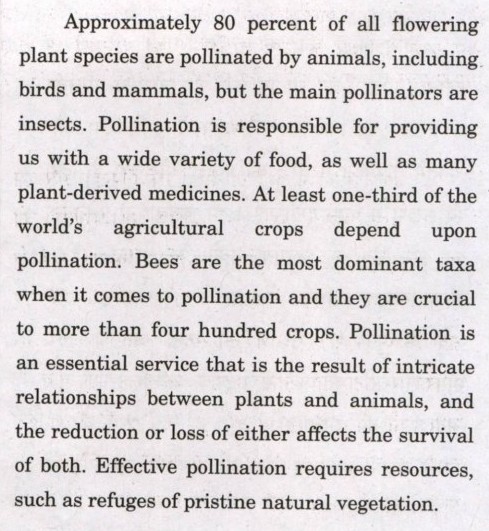
On the basis of the passage given above, the following assumptions have been made :
- 1.Sustainable production of India's cereal food grains is impossible without the diversity of pollinating animals.
- 2.Monoculture of horticultural crops hampers the survival of insects.
- 3.Pollinators become scarce in cultivated areas devoid of natural vegetation.
- 4.Diversity in insects induces diversity of plants.
Which of the above assumptions is/are valid ?
AnswerUPSC’s answer is (d).
Test each assumption against what the passage supports. Pollination depends on animals, mainly insects, and plants and their pollinators rise or fall together, so insect diversity goes with plant diversity (4). Effective pollination needs patches of wild vegetation nearby, so cultivated land stripped of it will have fewer pollinators (3). The passage says nothing about cereals or India, and nothing about monoculture of horticultural crops, so 1 and 2 go beyond it. Remember: in assumption questions, accept only what the passage states or directly implies, and discard specific crops, places or causes it never mentions.
- 1. Cereals and India are not discussed; the passage speaks of pollination in general.
- 2. Nothing is said about monoculture or horticultural crops.
- 3. Pollination needs wild vegetation nearby, so cultivated areas without it will have fewer pollinators.
- 4. Plants and pollinators depend on each other, so a diverse insect community goes with a diverse plant community.
How you could have got this
- If you were sure statement 1 is not correct, (a) and (c) go: each of them includes 1.
What you needed to know: Cereals and India are not discussed; the passage speaks of pollination in general.
- Then, if you were sure statement 2 is not correct, (b) goes: it includes 2.
What you needed to know: Nothing is said about monoculture or horticultural crops.
Only (d) is left. You didn’t need statements 3 or 4.
Which options go is worked out from UPSC’s key and the options, not by a model.
Why each option is right or wrong
- (a) Rests on assumption 1 alone, which brings in cereals and India; the passage covers neither.
- (b) Wrongly includes 2, a claim about monoculture of horticultural crops that the passage never makes.
- (c) Includes 1 and 2, both outside the passage, and leaves out the valid 3 and 4.
- (d) Right: 3 and 4 follow from the plant-pollinator interdependence and the need for wild vegetation nearby.
Answer: UPSC’s key. Explanation: written by UPSC Grade, not by UPSC.
Source: UPSC, Civil Services (Preliminary) Examination 2021, General Studies Paper II (CSAT), Series A. The paper on upsc.gov.in.