UPSC Prelims 2021 · CSAT
Question 14: Reading Comprehension
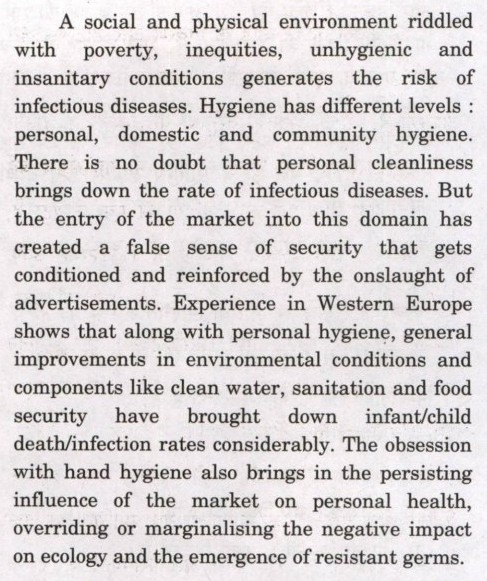
On the basis of the passage given above, the following assumptions have been made :
- 1.People who are obsessed with personal hygiene tend to ignore the community hygiene.
- 2.Emergence of multi-drug resistant germs can be prevented by personal cleanliness.
- 3.Entry of the market in the domain of hygiene increases the risk of infectious diseases.
- 4.Scientific and micro-level interventions are not sufficient to bring down the burden of infectious diseases.
- 5.It is community hygiene implemented through public health measures that is really effective in the battle against infectious diseases.
Which of the above assumptions are valid ?
AnswerUPSC’s answer is (c).
Match each assumption with the passage. Personal cleanliness lowers infection rates, but the market has encouraged overconfidence in individual hygiene, while in Western Europe cleaner water, sanitation and food security did much of the work. That supports 5 (community-level public health is what really works) and 4 (individual, micro-level measures are not enough). Nothing says hygiene-obsessed people neglect the community (1), the passage ties resistant germs to market-driven hygiene, not to its prevention (2), and it never says the market raises infection risk itself (3). Remember: avoid assumptions that reverse or overstate the passage's claims.
- 1. The passage does not say people focused on personal hygiene neglect community hygiene.
- 2. The passage links resistant germs to the market's hygiene push, not to personal cleanliness preventing them.
- 3. It says market-driven hygiene brings misplaced confidence, not that it raises infection risk.
- 4. Western Europe's gains came from wider environmental improvements as well as personal hygiene, so individual measures alone fall short.
- 5. Clean water, sanitation and food security, which are community-level measures, brought infection and child deaths down considerably.
How you could have got this
- If you were sure statement 5 is correct, (a), (b) and (d) go: each of them leaves 5 out.
What you needed to know: Clean water, sanitation and food security, which are community-level measures, brought infection and child deaths down considerably.
Only (c) is left. You didn’t need statements 1, 2, 3 or 4.
Which options go is worked out from UPSC’s key and the options, not by a model.
Why each option is right or wrong
- (a) 1 is not stated, and 2 reverses the passage, which links resistant germs to market-driven hygiene.
- (b) 3 overstates: the passage speaks of misplaced confidence from market hygiene, not higher infection risk.
- (c) Right: 4 and 5 follow from the Western Europe evidence on community-wide measures.
- (d) 1 and 2 are unsupported; of the three, only 4 is valid.
Answer: UPSC’s key. Explanation: written by UPSC Grade, not by UPSC.
Source: UPSC, Civil Services (Preliminary) Examination 2021, General Studies Paper II (CSAT), Series A. The paper on upsc.gov.in.