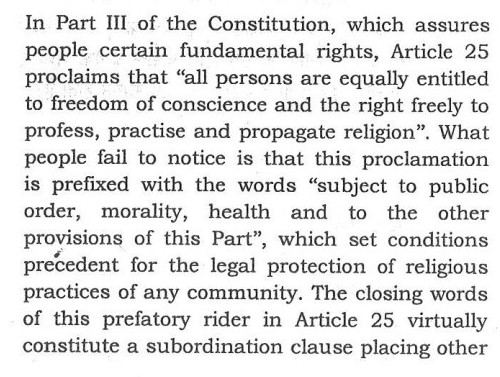
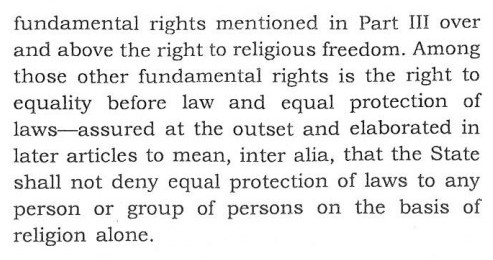
What is the most logical inference from the above passage?
aState shall not interfere with the religious affairs of the citizens.
bReligious freedom under the Constitution is open to State intervention.
cReligious freedom of the citizens is not covered under fundamental rights.
dReligious practices of any community are immune to State laws.
AnswerUPSC’s answer is (b).
The passage notes that Article 25 guarantees freedom of conscience and religion, but only subject to public order, morality, health and the other provisions of Part III, which rank other fundamental rights, such as equal protection of laws, above it. So religious freedom is not absolute and the State can step in through law. Religion is a fundamental right, but a conditional one.
Why each option is right or wrong
(a) The conditions on the right show the State can intervene.
(b) Right: the right is conditional on public order, morality, health and other rights.
(c) Article 25 sits in Part III, the fundamental rights part.
(d) Subjecting it to conditions means practices are not beyond State law.
Answer: UPSC’s key. Explanation: written by UPSC Grade, not by UPSC.