UPSC Prelims 2020 · CSAT
Question 26: Reading Comprehension
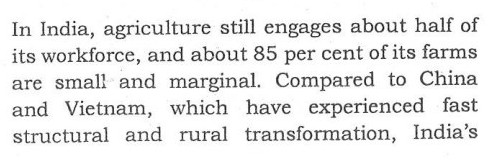
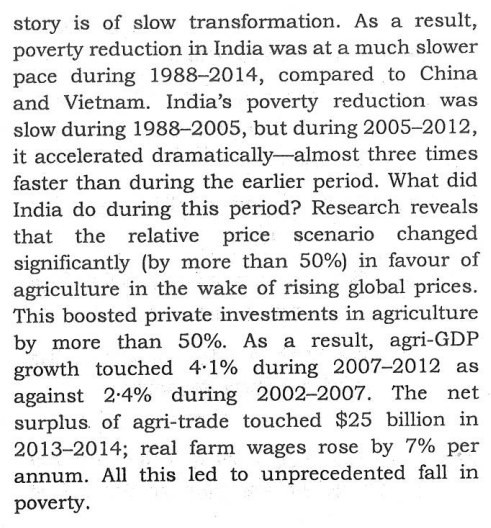
With reference to the above passage, the following assumptions have been made :
- 1.Structural and rural transformation is impossible when farms are mainly small and marginal.
- 2.A good price incentive can trigger investments in agriculture.
- 3.India needs to build value chains for high-value agri-products like livestock and horticulture.
- 4.Higher global prices of agricultural commodities are essential for India's poverty reduction.
Which of the above assumptions are valid?
AnswerUPSC’s answer is (c).
The passage links the quicker fall in poverty in 2005-2012 to a favourable shift in relative prices, which raised private investment in agriculture and farm growth: assumption 2 is valid. Assumption 4 overreads this, since rising global prices helped once but are not shown to be essential. Assumption 1 is too absolute: poverty fell fast even though most farms are small. UPSC counts 3 as valid, as a policy follow-on for raising farm incomes through higher-value produce.
- 1. Slow transformation is described, but poverty still fell fast when prices improved, so it is not called impossible.
- 2. A price shift in favour of farming lifted private farm investment by more than half.
- 3. Counted valid by UPSC: higher-value produce and the chains to market are a natural way forward for small farms.
- 4. Rising global prices helped in that period; the passage does not call them essential.
How you could have got this
- If you were sure statement 1 is not correct, (a) goes: it includes 1.
What you needed to know: Slow transformation is described, but poverty still fell fast when prices improved, so it is not called impossible.
- Then, if you were sure statement 4 is not correct, (b) and (d) go: each of them includes 4.
What you needed to know: Rising global prices helped in that period; the passage does not call them essential.
Only (c) is left. You didn’t need statements 2 or 3.
Which options go is worked out from UPSC’s key and the options, not by a model.
Why each option is right or wrong
- (a) Includes 1, which the passage does not say; slow change is noted, not impossibility.
- (b) Includes 4: higher global prices helped, but the passage does not call them essential.
- (c) Right per UPSC: 2 is in the passage; 3 is the accepted policy implication.
- (d) Includes 4, which overstates the passage, and omits 2, which is supported.
Worth knowing: The passage does not mention value chains, livestock or horticulture, so statement 3 rests on general policy sense; UPSC's key still counts it valid.
Answer: UPSC’s key. Explanation: written by UPSC Grade, not by UPSC.
Source: UPSC, Civil Services (Preliminary) Examination 2020, General Studies Paper II (CSAT), Series A. The paper on upsc.gov.in.