UPSC Prelims 2020 · CSAT
Question 21: Reading Comprehension
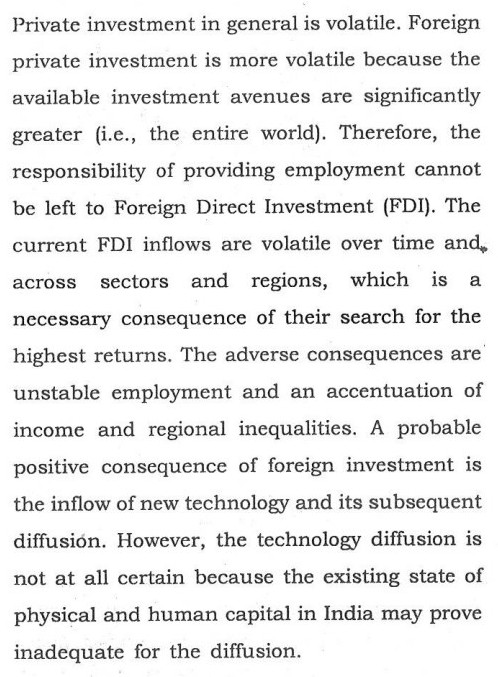
With reference to the above passage, the following assumptions have been made :
- 1.Relying on foreign investment in the long run is not an economically sound policy.
- 2.Policies must be undertaken to reduce volatility in foreign private investment.
- 3.Policies must be undertaken to strengthen domestic private investment.
- 4.Public investment should be given priority over private investment.
- 5.Substantial public investment in education and health should be undertaken.
Which of the above assumptions is/are valid?
AnswerUPSC’s answer is (b).
The passage says private investment is volatile, foreign investment more so, and employment cannot be left to it; it also doubts that technology will spread because India's physical and human capital are inadequate. So relying on foreign investment alone is unsound (1), domestic investment must be strengthened (3), and investment in human capital through education and health is needed (5). Volatility is described as built into foreign investors' search for returns, so policy to remove it (2) is not implied, and priority for public over private investment (4) is never stated.
- 1. Employment cannot be left to foreign investment because of its volatility and uneven effects.
- 2. Volatility is treated as a built-in result of investors chasing returns, not something the passage asks policy to remove.
- 3. If foreign money cannot carry employment, domestic investment must be strengthened.
- 4. Public investment is not ranked above private anywhere.
- 5. Inadequate human capital is cited as a barrier, so investment in education and health is implied.
How you could have got this
- If you were sure statement 1 is correct, (c) and (d) go: each of them leaves 1 out.
What you needed to know: Employment cannot be left to foreign investment because of its volatility and uneven effects.
- Then, if you were sure statement 2 is not correct, (a) goes: it includes 2.
What you needed to know: Volatility is treated as a built-in result of investors chasing returns, not something the passage asks policy to remove.
Only (b) is left. You didn’t need statements 3, 4 or 5.
Which options go is worked out from UPSC’s key and the options, not by a model.
Why each option is right or wrong
- (a) Includes 2 and 4, neither of which the passage supports.
- (b) Right: 1, 3 and 5 follow from the passage.
- (c) Includes 2 and 4, and misses 1 and 3.
- (d) 3 is valid but 1 and 5 are also supported, so 3 alone is incomplete.
Answer: UPSC’s key. Explanation: written by UPSC Grade, not by UPSC.
Source: UPSC, Civil Services (Preliminary) Examination 2020, General Studies Paper II (CSAT), Series A. The paper on upsc.gov.in.