UPSC Prelims 2018 · CSAT
Question 1: Basic Numeracy
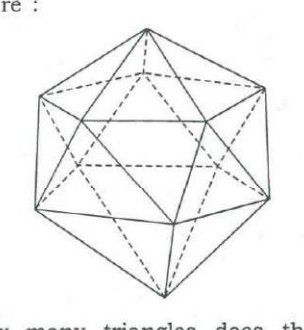
Consider the following three-dimensional figure :
How many triangles does the above figure have?
AnswerUPSC’s answer is (b).
The figure is an icosahedron, a solid with twenty triangular faces: five meet at the top vertex, five at the bottom vertex, and ten form the band between them. The dashed lines are only hidden edges of the back faces, so those faces still count. Check with a formula: there are 12 vertices, five faces meet at each, and every triangle uses three vertices, so faces = 12 × 5 ÷ 3 = 20. Euler's relation agrees: 12 - 30 + 20 = 2.
How you could have got this
No shortcut here: in a “how many” question, ruling out options doesn’t help. Every statement has to be judged.
Which options go is worked out from UPSC’s key and the options, not by a model.
Why each option is right or wrong
- (a) 18 misses some of the hidden back faces drawn with dashed lines.
- (b) Correct: 12 × 5 ÷ 3 = 20 triangular faces.
- (c) 22 is too many; the solid has no triangles beyond its twenty faces.
- (d) 24 is too many; it would need more faces than the 12-vertex count allows.
Answer: UPSC’s key. Explanation: written by UPSC Grade, not by UPSC.
Source: UPSC, Civil Services (Preliminary) Examination 2018, General Studies Paper II (CSAT), Series A. The paper on upsc.gov.in.