aIn a democracy, force is the main phenomenon in the actual exercise of sovereignty.
bIn a mature democracy, force to a great extent is the main phenomenon in the actual exercise of sovereignty.
cIn a mature democracy, use of force is irrelevant in the actual exercise of sovereignty.
dIn a mature democracy, force is narrowed down to a marginal phenomenon in the actual exercise of sovereignty.
AnswerUPSC’s answer is (d).
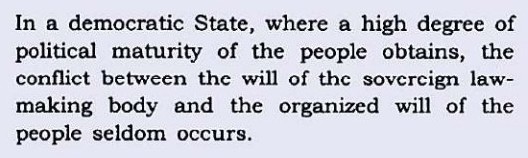
The passage says that in a democratic State with high political maturity, conflict between the sovereign law-making body's will and the people's organised will rarely arises. Force is needed mainly when such conflict occurs, so in a mature democracy force shrinks to a marginal role. Options saying force is the main phenomenon contradict this; saying it is irrelevant overstates, since rarely does not mean never.
Why each option is right or wrong
(a) Says force is the main phenomenon in any democracy, the opposite of the passage, which also speaks only of a mature one.
(b) Calls force largely the main phenomenon; the passage implies the reverse.
(c) Irrelevant overstates: conflict rarely occurs, not never, so force is marginal rather than absent.
(d) Correct: rare conflict leaves force only a marginal role in a mature democracy.
Answer: UPSC’s key. Explanation: written by UPSC Grade, not by UPSC.