UPSC Prelims 2016 · CSAT
Question 5: Reading Comprehension
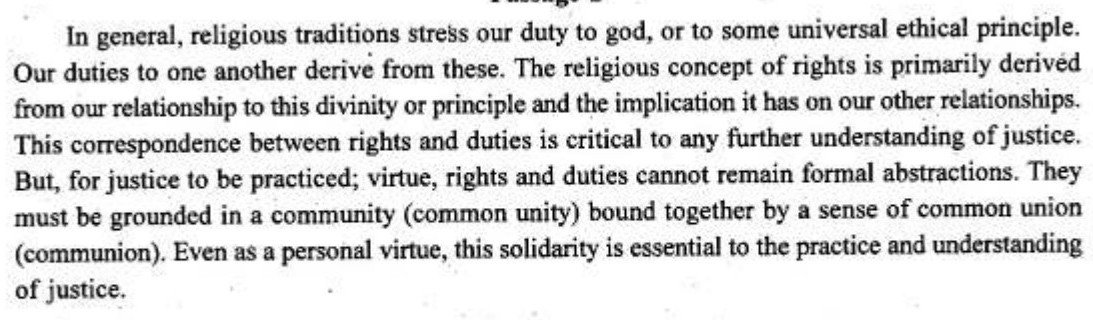
With reference to the passage, the following assumptions have been made :
- 1.Human relationships are derived from their religious traditions
- 2.Human beings can be duty bound only if they believe in god
- 3.Religious traditions are essential to practice and understand justice
Which of these assumption(s) is/are valid ?
AnswerUPSC’s answer is (a).
The passage ties duties between people to the religious duty owed to the divine, so human relationships derive from religious traditions (1 valid). It says the duty is owed to god or to some universal ethical principle, so belief in god is not required (2 invalid). For practising justice it stresses a community bound by shared solidarity, not religion itself (3 invalid). Remember: words like 'only if' and 'essential' make an assumption strong, so check whether the passage goes that far.
- 1. Duties to one another derive from the religious duty to the divine.
- 2. The duty can be to a universal ethical principle, so belief in god is not required.
- 3. Community solidarity, not religious tradition, is called essential to justice.
How you could have got this
- If you were sure statement 3 is not correct, (b), (c) and (d) go: each of them includes 3.
What you needed to know: Community solidarity, not religious tradition, is called essential to justice.
Only (a) is left. You didn’t need statements 1 or 2.
Which options go is worked out from UPSC’s key and the options, not by a model.
Why each option is right or wrong
- (a) Right: only assumption 1 is supported.
- (b) Assumption 2 needs belief in god; the passage allows a universal ethical principle too.
- (c) Assumption 3 over-reads: community solidarity, not religion, is called essential to justice.
- (d) Adds 2 and 3, both stronger than the passage.
Answer: UPSC’s key. Explanation: written by UPSC Grade, not by UPSC.
Source: UPSC, Civil Services (Preliminary) Examination 2016, General Studies Paper II (CSAT), Series A. The paper on upsc.gov.in.