UPSC Prelims 2016 · CSAT
Question 21: Reading Comprehension
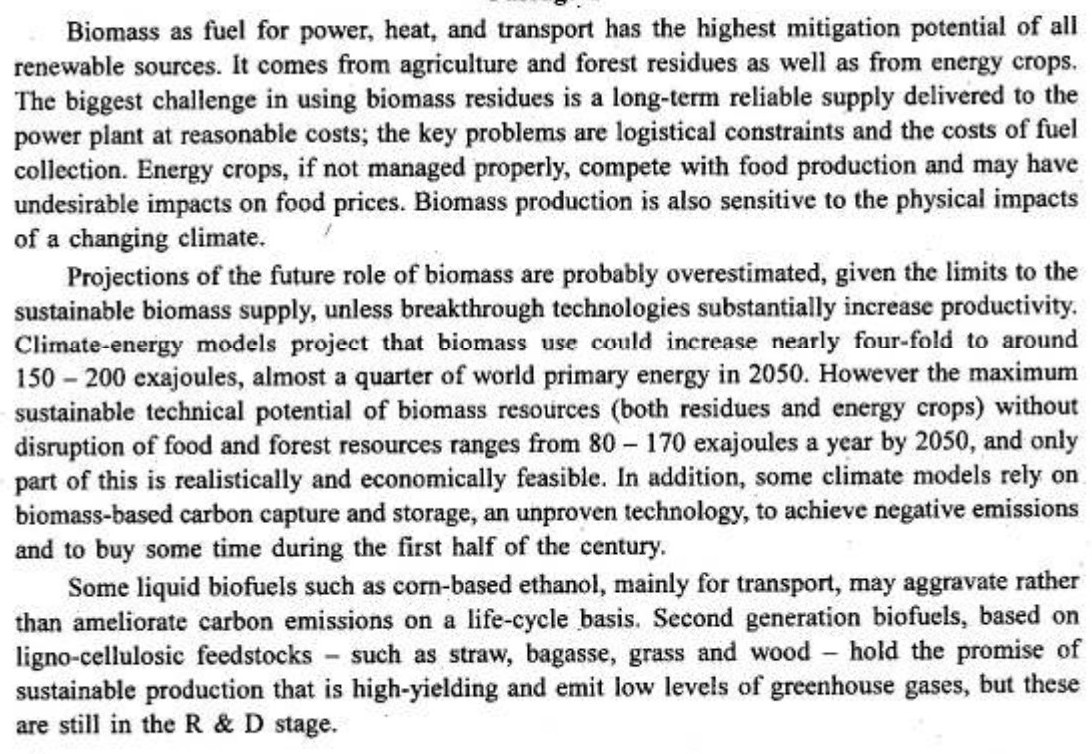
What is/are the present constraint/constraints in using biomass as fuel for power generation ?
- 1.Lack of sustainable supply of biomass
- 2.Biomass production competes with food production
- 3.Bio-energy may not always be low carbon on a life-cycle basis
Select the correct answer using the code given below :
AnswerUPSC’s answer is (d).
All three points follow from the passage. The biggest challenge is a long-term reliable supply at reasonable cost, and sustainable supply is limited (1). Energy crops, if badly managed, compete with food production and push up food prices (2). Some liquid biofuels, such as corn-based ethanol, may raise rather than cut emissions over their life cycle (3). So every statement is a present constraint. Remember: constraints are what limit use today, not future promises like second-generation fuels.
- 1. Reliable long-term supply is the biggest challenge and sustainable supply is limited.
- 2. Badly managed energy crops compete with food production.
- 3. Some liquid biofuels may worsen emissions over their life cycle.
How you could have got this
- If you were sure statement 1 is correct, (b) and (c) go: each of them leaves 1 out.
What you needed to know: Reliable long-term supply is the biggest challenge and sustainable supply is limited.
- Then, if you were sure statement 3 is correct, (a) goes: it leaves 3 out.
What you needed to know: Some liquid biofuels may worsen emissions over their life cycle.
Only (d) is left. You didn’t need statement 2.
Which options go is worked out from UPSC’s key and the options, not by a model.
Why each option is right or wrong
- (a) Statement 3 is also a stated constraint.
- (b) Statements 1 and 2 are constraints too.
- (c) Statement 1 is also stated.
- (d) Right: all three are constraints.
Answer: UPSC’s key. Explanation: written by UPSC Grade, not by UPSC.
Source: UPSC, Civil Services (Preliminary) Examination 2016, General Studies Paper II (CSAT), Series A. The paper on upsc.gov.in.