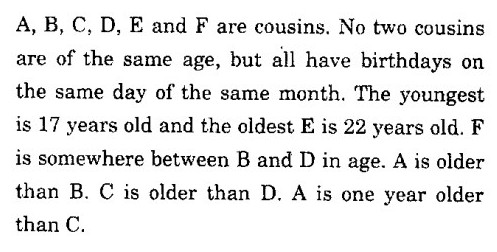
Six cousins of different ages, from 17 (youngest) up to 22 (E, the oldest), must be exactly 17, 18, 19, 20, 21 and 22. A is older than B, and one year older than C, who is older than D. F lies between B and D, so F is younger than the older of the two, hence younger than A. So A is the oldest after E: A = 21, C = 20. B, D and F take 17, 18 and 19, and F between B and D forces F = 18. So F can only be 18; D cannot be 20, as that is C's age.
Why each option is right or wrong
(a) Wrong: C is 20, so D, who is younger than C, cannot be 20.
(b) Right: F is 18 in every valid order.
(c) Wrong: F must be 18, as 19 goes to B or D.
(d) Wrong: 20 is C's age.
Answer: UPSC’s key. Explanation: written by UPSC Grade, not by UPSC.