UPSC Prelims 2015 · CSAT
Question 4: Reading Comprehension
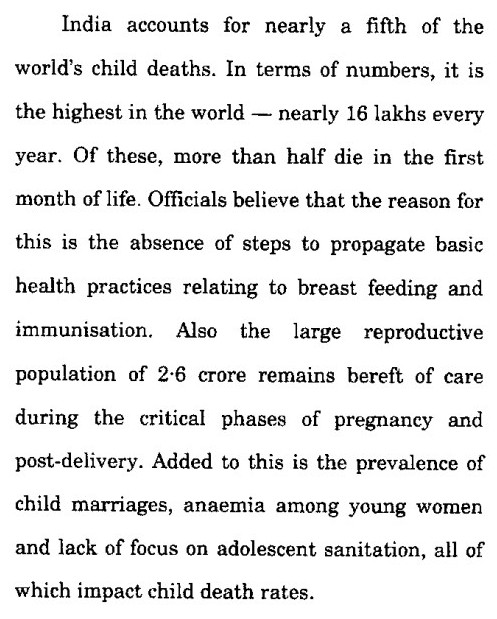
Which is the critical inference that can be made from the above passage ?
AnswerUPSC’s answer is (c).
The passage lists the causes of India's high child deaths: missing outreach on breastfeeding and immunisation, no care for women during pregnancy and after delivery, child marriage, anaemia in young women and neglect of adolescent sanitation. These are gaps in maternal and child health services, so the sound inference is that making those services universal and integrated would tackle the problem. Illiteracy and population size are not blamed, and the passage in fact links women's anaemia to child deaths. A critical inference follows from what is given without adding new causes.
Why each option is right or wrong
- (a) Wrong: illiteracy is never named as a cause; the passage points to missing outreach and care.
- (b) Wrong: nothing says the government cannot cope; the problem is gaps in services.
- (c) Right: the listed causes are gaps in maternal and child health services, so universal, integrated services follow.
- (d) Wrong: the passage says anaemia among young women affects child death rates, the opposite.
Answer: UPSC’s key. Explanation: written by UPSC Grade, not by UPSC.
Source: UPSC, Civil Services (Preliminary) Examination 2015, General Studies Paper II (CSAT), Series A. The paper on upsc.gov.in.