UPSC Prelims 2015 · CSAT
Question 1: Reading Comprehension
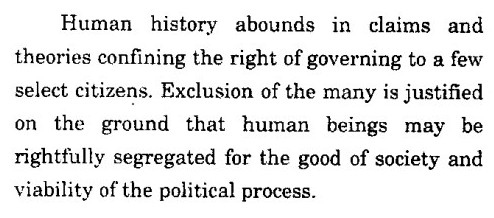
Which one of the following statements is least essential as a part of the argument in the above passage ?
AnswerUPSC’s answer is (a).
The argument is that governing is rightly confined to a few because people differ in ability and society's good needs that separation. Each statement that carries a step of this chain is essential: that society has higher and lower grades of people, that exceptions to universal participation help the system work, and that governing means recognising unequal capacities. The general remark that people try to control outside things that affect them is background about human nature; the argument stands without it. For 'least essential', drop the statement that carries no step of the reasoning.
Why each option is right or wrong
- (a) Right: a general remark about human nature; no step of the case for excluding many depends on it.
- (b) Wrong: the claim that people fall into higher and lower grades is the very ground for the exclusion.
- (c) Wrong: it gives the efficiency reason for excluding many, so it is part of the argument.
- (d) Wrong: recognising unequal capacities is what justifies limiting governance to a few.
Answer: UPSC’s key. Explanation: written by UPSC Grade, not by UPSC.
Source: UPSC, Civil Services (Preliminary) Examination 2015, General Studies Paper II (CSAT), Series A. The paper on upsc.gov.in.