UPSC Prelims 2013 · CSAT
Question 43: Reading Comprehension
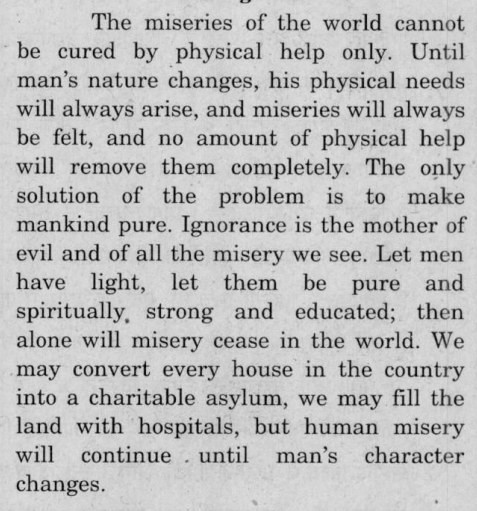
With reference to the passage, the following assumptions have been made :
- 1.The author gives primary importance to physical and material help in eradicating human misery.
- 2.Charitable homes, hospitals, etc. can remove human misery to a great extent.
Which of the assumptions is/are valid ?
AnswerUPSC’s answer is (d).
Statement 1 reverses the author's view: physical and material help is called insufficient, and the real remedy is to make people pure, spiritually strong and educated. Statement 2 also fails: the author says even if every house became a charitable home and the land were filled with hospitals, human misery would continue until character changes. Both assumptions conflict with the passage.
- 1. Material help is called insufficient; changing character comes first.
- 2. The author says homes and hospitals alone would not end misery.
How you could have got this
- If you were sure statement 1 is not correct, (a) and (c) go: each of them includes 1.
What you needed to know: Material help is called insufficient; changing character comes first.
- Then, if you were sure statement 2 is not correct, (b) goes: it includes 2.
What you needed to know: The author says homes and hospitals alone would not end misery.
Only (d) is left. This one needs every statement.
Which options go is worked out from UPSC’s key and the options, not by a model.
Why each option is right or wrong
- (a) Wrong. The author gives primary importance to a change of character, not to material help.
- (b) Wrong. The author says charitable homes and hospitals cannot end misery.
- (c) Wrong. Both assumptions contradict the passage.
- (d) Right. Neither assumption is valid.
Answer: UPSC’s key. Explanation: written by UPSC Grade, not by UPSC.
Source: UPSC, Civil Services (Preliminary) Examination 2013, General Studies Paper II (CSAT), Series A. The paper on upsc.gov.in.