UPSC Prelims 2013 · CSAT
Question 37: Reading Comprehension
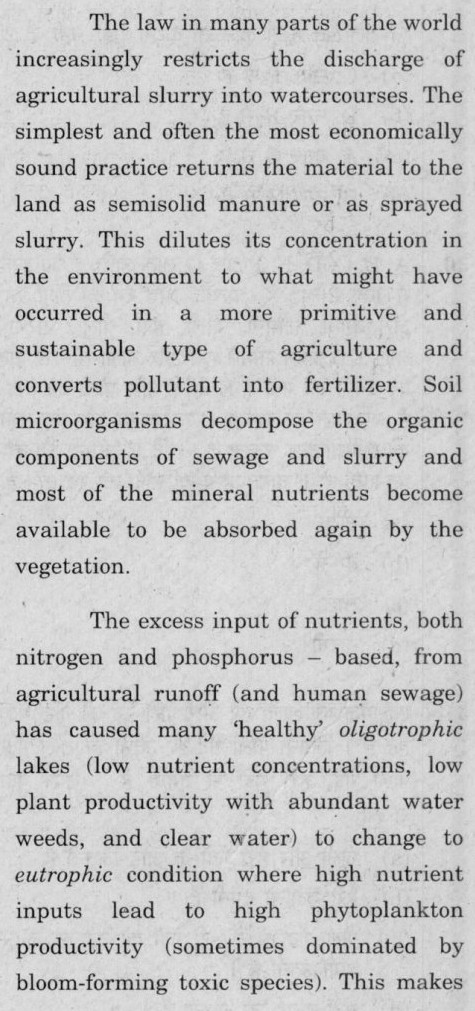
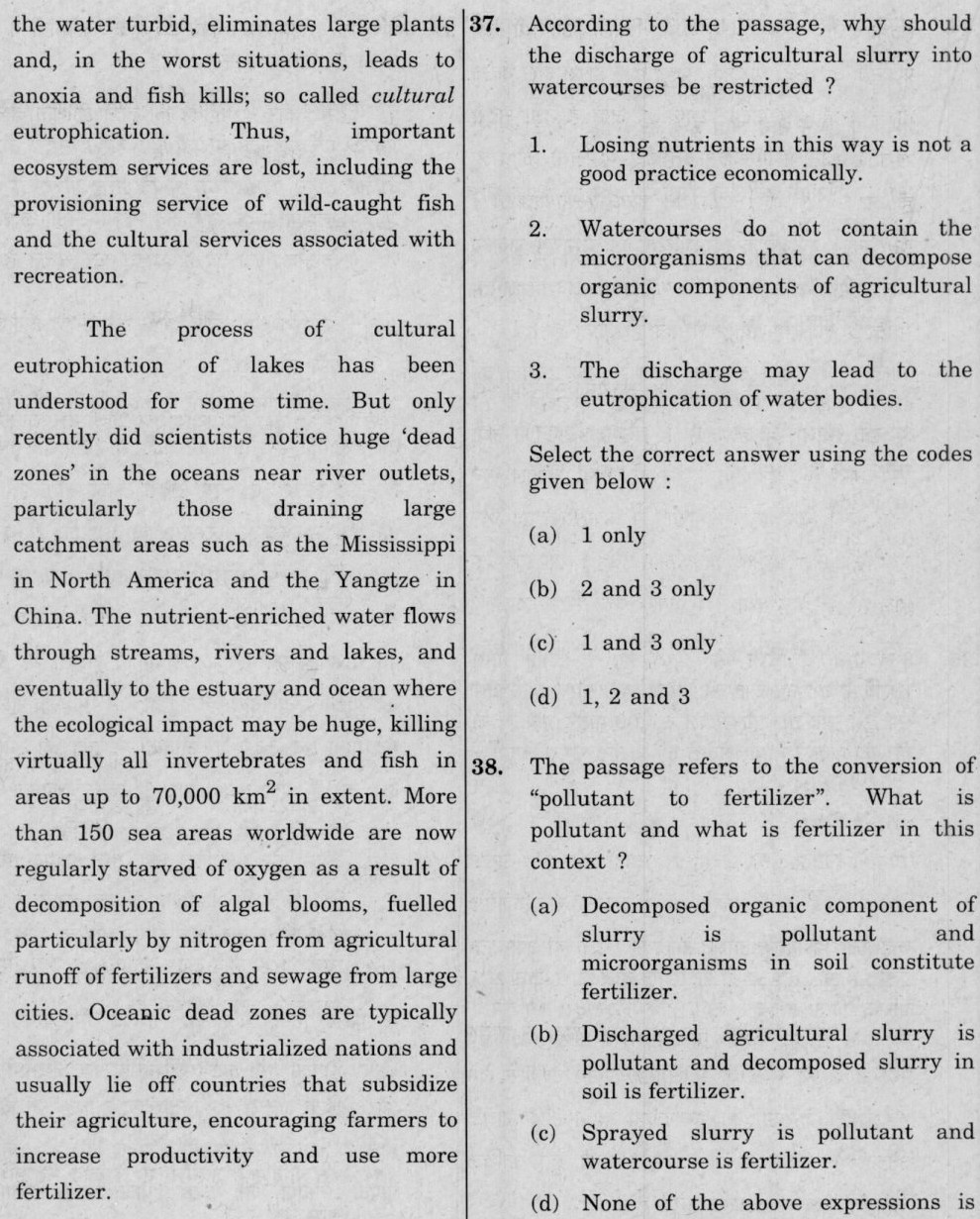
According to the passage, why should the discharge of agricultural slurry into watercourses be restricted ?
- 1.Losing nutrients in this way is not a good practice economically.
- 2.Watercourses do not contain the microorganisms that can decompose organic components of agricultural slurry.
- 3.The discharge may lead to the eutrophication of water bodies.
Select the correct answer using the codes given below :
AnswerUPSC’s answer is (c).
The passage calls returning slurry to the land, as manure or spray, the simplest and often most economical practice, so letting nutrients flow away into watercourses wastes them: statement 1 holds. It also explains that excess nutrients in water bodies drive eutrophication: statement 3 holds. Statement 2 is a misreading: the microorganisms that break down slurry are described as living in the soil, and the passage never says watercourses lack them.
- 1. Returning slurry to land is called economically sound, so losing nutrients to water is wasteful.
- 2. Decomposers are described in soil; nothing says watercourses lack them.
- 3. Excess nutrients from runoff lead lakes towards eutrophication.
How you could have got this
- If you were sure statement 2 is not correct, (b) and (d) go: each of them includes 2.
What you needed to know: Decomposers are described in soil; nothing says watercourses lack them.
- Then, if you were sure statement 3 is correct, (a) goes: it leaves 3 out.
What you needed to know: Excess nutrients from runoff lead lakes towards eutrophication.
Only (c) is left. You didn’t need statement 1.
Which options go is worked out from UPSC’s key and the options, not by a model.
Why each option is right or wrong
- (a) Wrong. It leaves out the eutrophication risk in statement 3.
- (b) Wrong. Statement 2 is not supported; the passage does not say watercourses lack decomposers.
- (c) Right. Wasted nutrients and the risk of eutrophication are the reasons given.
- (d) Wrong. It includes unsupported statement 2.
Answer: UPSC’s key. Explanation: written by UPSC Grade, not by UPSC.
Source: UPSC, Civil Services (Preliminary) Examination 2013, General Studies Paper II (CSAT), Series A. The paper on upsc.gov.in.