UPSC Prelims 2012 · CSAT
Question 56: Reading Comprehension
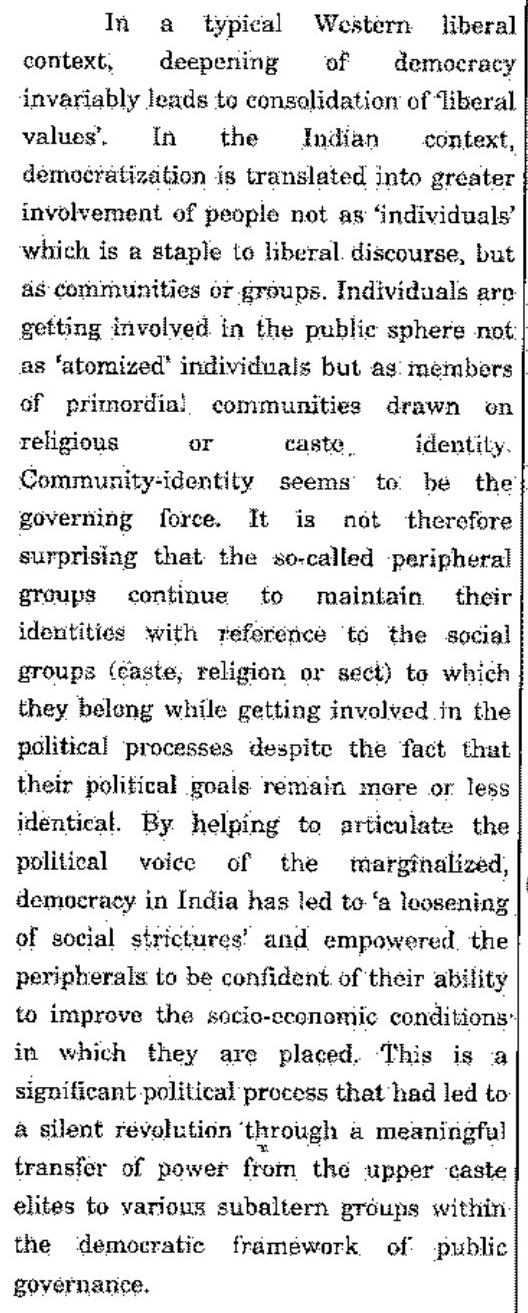
What is the “silent revolution” that has occurred in the Indian democratic process ?
AnswerUPSC’s answer is (c).
The passage's silent revolution is power passing from the upper-caste elite to subaltern groups through ordinary democratic politics. Democracy helped marginalised groups voice their political demands and eased social restrictions, which is how the shift came about. So the answer is (c). Option (a) is wrong because community identity remains a governing force, and (b) names a contributing process, not the revolution itself.
Why each option is right or wrong
- (a) Wrong. Caste and class hierarchies remain relevant; community identity still drives politics.
- (b) Wrong. Loosening of social strictures accompanies the change but is not the revolution itself.
- (c) Right. The transfer of power from upper-caste elites to subaltern groups is the silent revolution.
- (d) Wrong. (a) is not true, so the three cannot all be correct.
Answer: UPSC’s key. Explanation: written by UPSC Grade, not by UPSC.
Source: UPSC, Civil Services (Preliminary) Examination 2012, General Studies Paper II (CSAT), Series A. The paper on upsc.gov.in.